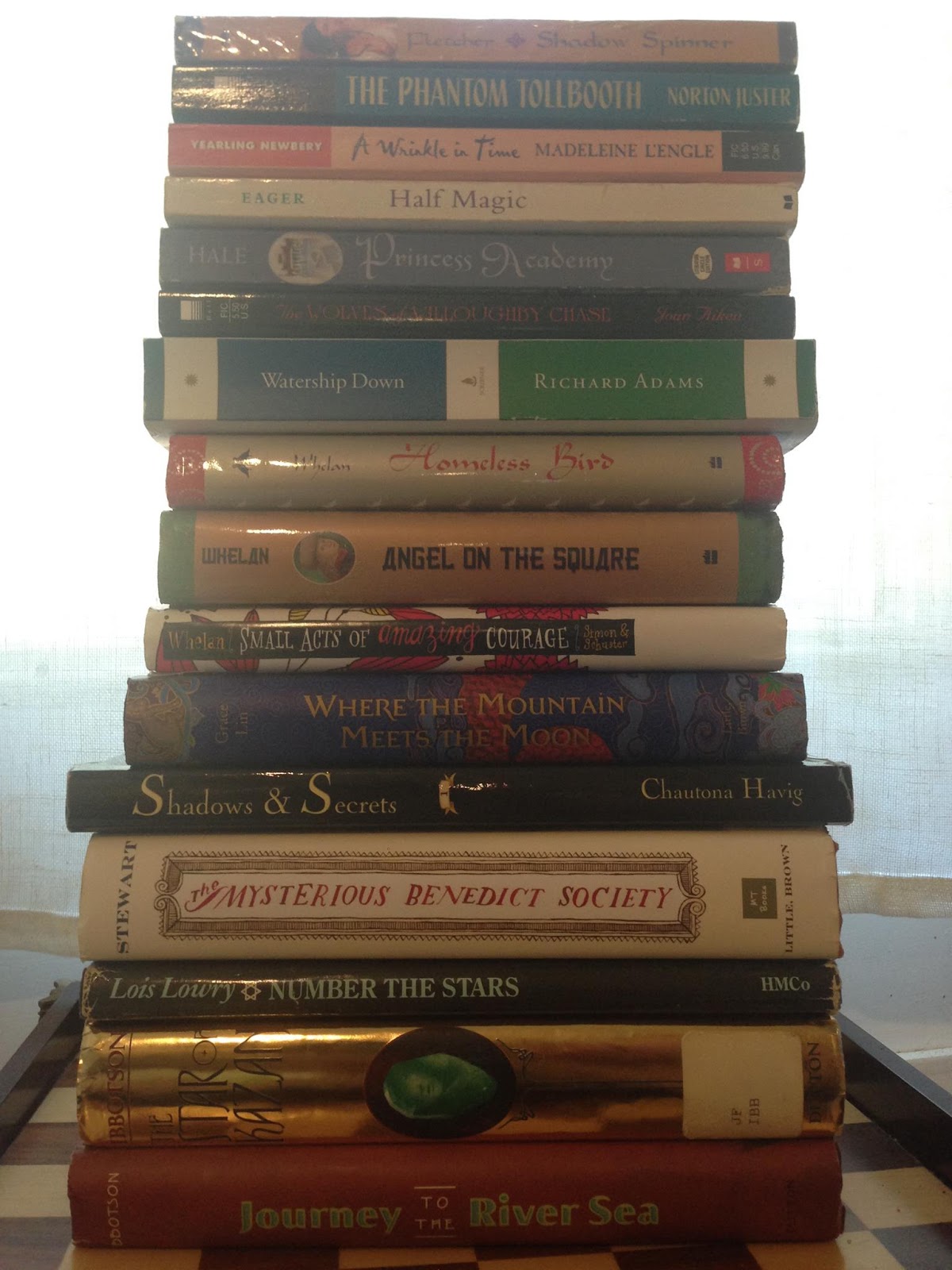
The other day a 10 year old friend asked my almost-14 year old daughter for book recommendations, and this is what my daughter pulled out. I found her choices interesting, and her list a good one, so I thought I'd share it. It's that time of year when all my favorite book bloggers, as well as every public library, is coming out with a Summer Reading List. Well, life is busy, so this is about as close to that as you're going to get from me. List below, with Amazon links (remember, I am not an affiliate).
(top to bottom)
Shadow Spinner - by Susan Fletcher
The Phantom Tollbooth - Norton Juster
A Wrinkle in Time - Madeleine L'Engle
Half Magic - Edward Eager
Princess Academy - Shannon Hale
The Wolves of Willoughby Chase - Joan Aiken
Watership Down - Richard Adams
Homeless Bird - Gloria Whelan: Daughter would like to say that this is her favorite of Whelan's books.
Angel on the Square - Gloria Whelan: I can't recommend this one enough. It's actually the first in a series of four books about 4 generations of a Russian family in St Petersburg/Leningrad, though all the changes and upheaval that took place from the time of the last tsar, to the fall of the Soviet Union.
Small Acts of Amazing Courage - Gloria Whelan: Can you tell we are Whelan fans? If you like this one, don't miss the sequel, All My Noble Dreams and then What Happens.
Where the Mountain Meets the Moon - Grace Lin: Another don't miss is Lin's Starry River of the Sky, a companion volume that can stand alone. I think I enjoyed it more than Mountain, though both books are simply beautiful.
Shadows & Secrets - Chautona Havig: DD says: read the whole trilogy!
The Mysterious Benedict Society - Trenton Lee Stewart
Number the Stars by Lois Lowry: If I had a Top Ten List of Children's Books, this one would be on it.
The Start of Kazan - Eva Ibbotson
Journey to the River Sea - Eva Ibbotson: If you read one of these, you will want to read everything of Ibbotson's: I don't recommend that, lol. But definitely read these two!
Come to think of it, I'm due for a re-read of at least five of these - I think I know what I'll be doing this summer! What do you think - see anything you think you will read this summer? Or recommend to someone you love? Or any of your favorites? Do tell!
Showing posts with label book lists. Show all posts
Thursday, June 16, 2016
Monday, August 3, 2015
Renaissance and reformation: literature and free reads
We don't always coordinate our literature selections to the history period we are studying in our homeschool, but as our students get older it happens more frequently. This year, I have chosen two main novels of enduring literary and historic value for my Year 8 student to read. It is my hope that the rich vocabulary will proffer a vivid picture of the times and places described, and that each will speak truths about human nature, and of the relationship between God and man.
Westward Ho! by Charles Kingsley - If ever a book gave a flavor of the times, this is one. Set in Elizabethan England, the ins and outs of 16th century religion, politics, and warfare all come into play in the hero Amyas Leigh's life. Amyas sails and explores, fights Spanish invaders in Ireland, and in the end, gets the girl; his integrity and faith guiding him through it all.
I Promessi Sposi (The Betrothed) by Alesandro Manzoni - another book that is new to me, Amazon had this to say about it: " The Betrothed's exploration of love, power and faith presents a whirling panorama of seventeenth-century Italian life and is one of the greatest European historical novels."
(Both of the above books are also available free in Kindle or ebook format.)
And because I can't keep my daughter in books, I have also added these rather easier reads to her schedule this year:
The King's Fifth by Scott O'Dell (1541) - recounts the adventures and trial of Spanish mapmaker Julian Escobar in the New World. So good, truly.
The Explorations of Pere Marquette by Jim Kjelgaard (1670) - okay, this is actually a non-fiction title, from the much acclaimed Landmark Series; this book recounts the travels of French Jesuit Marquette (and his friend Joliet) as they explore the Mississippi river and environs.
A Parcel of Patterns by Jill Paton Walsh (1665) - I picked up this small volume one night and could not put it down until the last page. Based on the true story of how the Plague devastated the English village of Eyam, it is a haunting story of love and loss, but also a thoughtful look at the convergence of religion, politics, and science in the 17th century.
And because my 4th, 6th, and 8th grade students are all studying this same time period, I have chosen a few books to read aloud that we can all enjoy, though every book on this list would make an excellent free read choice as well. All are appropriate for younger children as well, though they may find The Black Arrow a bit dull.
The Black Arrow by Robert Louis Stevenson (1460-61) Set during the War of the Roses, young Dick Shelton finds himself betrayed by his treacherous guardian, and torn between conflicting loyalties with the houses of York and Lancaster, as he seeks to become a knight and rescue his lady love. Truthfully, this should have been a part of last year's studies, but hey - I can't always get it perfect.
The Hawk That Dare Not Hunt by Day by Scott O'Dell (early 1500s, during the reign of Henry VIII) - while his uncle is merely out for profit, young smuggler Tom Barton sees that the writing of one Martin Luther, and William Tyndale's hopes of an English Bible, are changing the lives of English men and woman and ushering in the dawning of a new age.
Unknown to History; The Captivity of Mary of Scotland by Charlotte Yonge (1567) - it seems that every British child knows the story of Mary, Queen of Scots, but if I ever learned it, I've forgotten it. Through the story of the Talbot family and their foundling daughter, Cicely, we read here of Mary's captivity and her conflicts with Queen Elizabeth I. (available free for Kindle or ereader)
Red Hugh, Prince of Donegal by Robert C. Reilly (1580) - an exciting and adventurous tale based on a true story from Irish history - that of Red Hugh's capture, imprisonment, and escape from his Elizabethan English enemies. A story of bravery, loyalty, and perseverance.
I Will Adventure by Elizabeth Janet Grey - (1596) - I randomly picked up this out-of-print book at a sale, and am glad a did. A quick and easy read, the story follows Andrew, who is sent from his home in Canterbury to become a page to his London uncle, but what he really wants is to be apart of the exciting theatrics of Mr. Shakespeare.
The Children of the New Forest by Frederick Marryat (1647) - Set in England during the time of the Civil War, four children, whose royalist father was killed fighting for King Charles, flee their burning ancestral home, and take up residence with Jacob Armitage, a keeper in the New Forest. An exciting and detailed look at a very volatile time.
Master Cornhill by Eloise Jarvis McGraw - (1666) Full of detail about life and customs in 17th century London, this story centers around Michael, orphaned during the great plague, and left to fend for himself in the city. He befriends a balladeer, a map maker, and his lively housekeeper Susanna, but that only seems to make it worse once the Great Fire sweeps through London, threatening them all...
The Witch of Blackbird Pond by Elizabeth George Speare (1687) - 16 year old Kit finds it difficult to adjust to life with her uncle's family in Puritan Connecticut, after growing up in sunny Barbados. The colonists, in turn, have a hard time understanding her different ways, especially after she befriends a Quaker woman that is already regarded as a witch. I originally intended to assign this book in Term 3, but decided instead to read it aloud to all my children - I believe everyone from the 7 to 13 year old will enjoy it, and I don't doubt the younger children will pick up more than I expect!
Disclaimer: I am NOT an Amazon affiliate. Clicking the above links will get me nothing. though it may give you helpful information :)
Westward Ho! by Charles Kingsley - If ever a book gave a flavor of the times, this is one. Set in Elizabethan England, the ins and outs of 16th century religion, politics, and warfare all come into play in the hero Amyas Leigh's life. Amyas sails and explores, fights Spanish invaders in Ireland, and in the end, gets the girl; his integrity and faith guiding him through it all.
I Promessi Sposi (The Betrothed) by Alesandro Manzoni - another book that is new to me, Amazon had this to say about it: " The Betrothed's exploration of love, power and faith presents a whirling panorama of seventeenth-century Italian life and is one of the greatest European historical novels."
(Both of the above books are also available free in Kindle or ebook format.)
And because I can't keep my daughter in books, I have also added these rather easier reads to her schedule this year:
The King's Fifth by Scott O'Dell (1541) - recounts the adventures and trial of Spanish mapmaker Julian Escobar in the New World. So good, truly.
The Explorations of Pere Marquette by Jim Kjelgaard (1670) - okay, this is actually a non-fiction title, from the much acclaimed Landmark Series; this book recounts the travels of French Jesuit Marquette (and his friend Joliet) as they explore the Mississippi river and environs.
A Parcel of Patterns by Jill Paton Walsh (1665) - I picked up this small volume one night and could not put it down until the last page. Based on the true story of how the Plague devastated the English village of Eyam, it is a haunting story of love and loss, but also a thoughtful look at the convergence of religion, politics, and science in the 17th century.
And because my 4th, 6th, and 8th grade students are all studying this same time period, I have chosen a few books to read aloud that we can all enjoy, though every book on this list would make an excellent free read choice as well. All are appropriate for younger children as well, though they may find The Black Arrow a bit dull.
The Black Arrow by Robert Louis Stevenson (1460-61) Set during the War of the Roses, young Dick Shelton finds himself betrayed by his treacherous guardian, and torn between conflicting loyalties with the houses of York and Lancaster, as he seeks to become a knight and rescue his lady love. Truthfully, this should have been a part of last year's studies, but hey - I can't always get it perfect.
The Hawk That Dare Not Hunt by Day by Scott O'Dell (early 1500s, during the reign of Henry VIII) - while his uncle is merely out for profit, young smuggler Tom Barton sees that the writing of one Martin Luther, and William Tyndale's hopes of an English Bible, are changing the lives of English men and woman and ushering in the dawning of a new age.
Unknown to History; The Captivity of Mary of Scotland by Charlotte Yonge (1567) - it seems that every British child knows the story of Mary, Queen of Scots, but if I ever learned it, I've forgotten it. Through the story of the Talbot family and their foundling daughter, Cicely, we read here of Mary's captivity and her conflicts with Queen Elizabeth I. (available free for Kindle or ereader)
Red Hugh, Prince of Donegal by Robert C. Reilly (1580) - an exciting and adventurous tale based on a true story from Irish history - that of Red Hugh's capture, imprisonment, and escape from his Elizabethan English enemies. A story of bravery, loyalty, and perseverance.
I Will Adventure by Elizabeth Janet Grey - (1596) - I randomly picked up this out-of-print book at a sale, and am glad a did. A quick and easy read, the story follows Andrew, who is sent from his home in Canterbury to become a page to his London uncle, but what he really wants is to be apart of the exciting theatrics of Mr. Shakespeare.
The Children of the New Forest by Frederick Marryat (1647) - Set in England during the time of the Civil War, four children, whose royalist father was killed fighting for King Charles, flee their burning ancestral home, and take up residence with Jacob Armitage, a keeper in the New Forest. An exciting and detailed look at a very volatile time.
Master Cornhill by Eloise Jarvis McGraw - (1666) Full of detail about life and customs in 17th century London, this story centers around Michael, orphaned during the great plague, and left to fend for himself in the city. He befriends a balladeer, a map maker, and his lively housekeeper Susanna, but that only seems to make it worse once the Great Fire sweeps through London, threatening them all...
The Witch of Blackbird Pond by Elizabeth George Speare (1687) - 16 year old Kit finds it difficult to adjust to life with her uncle's family in Puritan Connecticut, after growing up in sunny Barbados. The colonists, in turn, have a hard time understanding her different ways, especially after she befriends a Quaker woman that is already regarded as a witch. I originally intended to assign this book in Term 3, but decided instead to read it aloud to all my children - I believe everyone from the 7 to 13 year old will enjoy it, and I don't doubt the younger children will pick up more than I expect!
Disclaimer: I am NOT an Amazon affiliate. Clicking the above links will get me nothing. though it may give you helpful information :)
Monday, July 27, 2015
Early American history with historical fiction
I was cleaning my desk and found a list I had scribbled out when someone asked me about living books for early American history. And, because I must have been in a fastidious mood that night, I even arranged the books in chronological order. It's too good of a list to just throw away, and I will lose it in a heartbeat if I try to save it, so I am posting it here for all posterity. Know too, that for purposes of this list I defined "early American history" roughly as the time from Columbus to about the year 1800.
Pedro's Journal by Pam Conrad (1492-93) the fictional diary of a ship's boy on Columbus' vessel Santa Maria.
Walk the World's Rim by Betty Baker (1527+) A 14-year old Indian joins Cabeza de Vaca's expedition through the Southwest.
Conquista! (1541) - an early chapter book about a young native American who encounters his first horse.
The King's Fifth by Scott O'Dell (1541) - recounts the adventures and trial of Spanish mapmaker Julian Escobar in the New World.
The Lost Colony of Roanoke (1587) - a non-fiction title from Jean Fritz, recounting the mystery surrounding one of the earliest attempted colonies in the New World.
Landing of the Pilgrims by James Daugherty (1620) - One of the highly esteemed Landmark Books, tells of the coming of English Puritans to Plymouth.
The Scarlet Letter (1642) - an excellent literature selection for older students, this powerful psychological novel explores themes of sin, guilt, and redemption in the early Massachusetts Colony.
The Explorations of Pere Marquette (1670) - another non-fiction Landmark title, this book recounts the travels of French Jesuit Marquette (and his friend Joliet) as they explore the Mississippi river and environs.
The Witch of Blackbird Pond (1687) - 16 year old Kit finds it difficult to adjust to life with her uncle's family in Puritan Connecticut, after growing up in sunny Barbados. The colonists, in turn, have a hard time understanding her different ways, especially after she befriends a Quaker woman that is already regarded as a witch.
Madeline Takes Command (1692) - with her parents away, 14-year old Madeline is left to defend a fort on the St Lawrence River against an Indian attack.
Om-kas-toe (early 1700s) -fictional tale of the Blackfeet tribes first encounters with the horse.
Amos Fortune, Freeman - Spanning the whole of Amos' life, from 1710 to 1801, in which he is kidnapped in Africa and sold into slavery in Massachusettes, where he dreams of and plans for freedom for 45 years.
Indian Captive (1743) -well done fictionalization of the story of Mary Jemmison, who is captured in a raid as a young girl, and lives out the rest of her life with the Seneca Tribe.
Calico Captive (1754) - more engaging historical fiction, recounting the trials of Miriam Willard, who is taken from her home in New Hampshire during a raid, and sent to Quebec during the French and Indian Wars.
The Last of the Mohicans (1754-1763) - paints an excellent picture of frontier life and struggles that made up the French and Indian War, this a must read for high school students. And though I don't often recommend adaptations, THIS ONE is particularly good.
Sign of the Beaver (1768) - 13 year old Matt faces teh task of guarding his family's new cabin in the wilderness bravely - until a wandering stranger steals his gun and leaves him feeling vulnerable. But a friendship with Attean, a boy of the Beaver clan, teaches him more than just practical survival skills.
A Light in the Forest (1769) - not just another story about a white boy living with Indians, this well crafted story explores the ways in we create any identity for ourselves.
Johnny Tremain (1773) -Bitterly disappointed over an tragic accident that ended his days as an apprentice silversmith, Johnny finds that his new job as a dispatch rider brings him in contact with Boston patriots and the excitement that leads up to the Boston Tea Party and the Battle of Lexington.
Early Thunder (1774-75) - a 14 year old boy who has been raised as a royalist begins to questions his loyalties as the event of history unfold in Salem, Massachusettes.
The Cabin Faced West (1784) - a simple story of life on the Pennsylvanian frontier, with a fun cameo by George Washington himself.
The Reb and the Redcoats (1779-80) - An interesting look at the American Revolution, as told from the point of view of a British family who takes in an American prisoner of war.
Pedro's Journal by Pam Conrad (1492-93) the fictional diary of a ship's boy on Columbus' vessel Santa Maria.
Walk the World's Rim by Betty Baker (1527+) A 14-year old Indian joins Cabeza de Vaca's expedition through the Southwest.
Conquista! (1541) - an early chapter book about a young native American who encounters his first horse.
The King's Fifth by Scott O'Dell (1541) - recounts the adventures and trial of Spanish mapmaker Julian Escobar in the New World.
The Lost Colony of Roanoke (1587) - a non-fiction title from Jean Fritz, recounting the mystery surrounding one of the earliest attempted colonies in the New World.
Landing of the Pilgrims by James Daugherty (1620) - One of the highly esteemed Landmark Books, tells of the coming of English Puritans to Plymouth.
The Scarlet Letter (1642) - an excellent literature selection for older students, this powerful psychological novel explores themes of sin, guilt, and redemption in the early Massachusetts Colony.
The Explorations of Pere Marquette (1670) - another non-fiction Landmark title, this book recounts the travels of French Jesuit Marquette (and his friend Joliet) as they explore the Mississippi river and environs.
The Witch of Blackbird Pond (1687) - 16 year old Kit finds it difficult to adjust to life with her uncle's family in Puritan Connecticut, after growing up in sunny Barbados. The colonists, in turn, have a hard time understanding her different ways, especially after she befriends a Quaker woman that is already regarded as a witch.
Madeline Takes Command (1692) - with her parents away, 14-year old Madeline is left to defend a fort on the St Lawrence River against an Indian attack.
Om-kas-toe (early 1700s) -fictional tale of the Blackfeet tribes first encounters with the horse.
Amos Fortune, Freeman - Spanning the whole of Amos' life, from 1710 to 1801, in which he is kidnapped in Africa and sold into slavery in Massachusettes, where he dreams of and plans for freedom for 45 years.
Indian Captive (1743) -well done fictionalization of the story of Mary Jemmison, who is captured in a raid as a young girl, and lives out the rest of her life with the Seneca Tribe.
Calico Captive (1754) - more engaging historical fiction, recounting the trials of Miriam Willard, who is taken from her home in New Hampshire during a raid, and sent to Quebec during the French and Indian Wars.
The Last of the Mohicans (1754-1763) - paints an excellent picture of frontier life and struggles that made up the French and Indian War, this a must read for high school students. And though I don't often recommend adaptations, THIS ONE is particularly good.
Sign of the Beaver (1768) - 13 year old Matt faces teh task of guarding his family's new cabin in the wilderness bravely - until a wandering stranger steals his gun and leaves him feeling vulnerable. But a friendship with Attean, a boy of the Beaver clan, teaches him more than just practical survival skills.
A Light in the Forest (1769) - not just another story about a white boy living with Indians, this well crafted story explores the ways in we create any identity for ourselves.
Johnny Tremain (1773) -Bitterly disappointed over an tragic accident that ended his days as an apprentice silversmith, Johnny finds that his new job as a dispatch rider brings him in contact with Boston patriots and the excitement that leads up to the Boston Tea Party and the Battle of Lexington.
Early Thunder (1774-75) - a 14 year old boy who has been raised as a royalist begins to questions his loyalties as the event of history unfold in Salem, Massachusettes.
The Cabin Faced West (1784) - a simple story of life on the Pennsylvanian frontier, with a fun cameo by George Washington himself.
The Reb and the Redcoats (1779-80) - An interesting look at the American Revolution, as told from the point of view of a British family who takes in an American prisoner of war.
Friday, December 19, 2014
The Middle Ages for middle school
Once again I have three drafts open on my desktop, yet here I am starting a new post. Anyone who is a writer knows: some stories fight you, and some beg to be written. But I'm not telling stories here, I'm telling you *about* stories. Specifically, medieval stories, since that's where we've been in our history cycle for oh, the last 15 weeks or so (Eep!) I wanted to share our books with you way back then, but I was preparing up until (and past!) the last minute, and we just jumped in full steam ahead. Now that it's Christmas break, I have a little breathing room, so without further ado, here are some of the books my 12 year old 7th grader is reading this year, as we delve into the Middle Ages and study the geography of Europe.
Oh, and you should know that I base our lessons largely on Ambleside Online's curriculum, which you can (and should!) check out by clicking on the link above. However, I make several modifications and changes to suit our family's needs and interests.
My daughter's main history texts this year (or "spines) are:
Winston Churchill's The Birth of Britain
- Truthfully, she finds it a little dull, but we are sticking with it. It is the first volume of Churchill's History of the English Speaking People, a four volume set.
The Story of Europe by H.E. Marshall
- Some people love Marshall's writing. I don't think it is spectacular, but again, this book meets a need, and does it in the simple, storytelling way that we like. I like that dates of important events are in the margins and footnotes, so as not to interrupt the narrative, and that it does not focus solely on Great Britain, like so many other books covering the same time period.
The Story of the English, vol 1
- I DO love Helene Guerber's writing, and after enjoying her Story of the Greeks and Story of the Romans last year, my daughter begged me to include this books this year. Many of the stories will be ones she had also read elsewhere, but since she wanted to read it, I did not object.
For biographies, I chose:
King Alfred the Great by Jacob Abbott
- I cannot understand why this book is no longer in print, but it is worth reading about one of the most famous kings in British history. This book is also sometimes called King Alfred of England.
The Magna Carta by James Daughtery
- Part biography of King John, part biography of the document itself, I read this book a few years ago, and enjoyed it while also learning a few things. Win.
Saint Joan: The Girl Soldier
- Another option might be Landmark Books' Joan of Arc. Both of these could be considered rather easy reads for a middle schooler, but not everything has to be Shakespeare. And they are well done besides.
I would have loved to have my daughter read George Makepeace Towle's telling of Marco Polo: His Travels and Adventures too, but there just wasn't room this year. I solved this problem by deciding to read it aloud to my elementary schoolers, while she listens in :D I love homeschooling! If your student is a male, he may prefer reading this story over Joan of Arc's.
And, because I cannot keep my daughter in books, I like to add a few historical fiction titles to her plans. Historical fiction is my all time favorite way to learn history. This year she is enjoying:
A Proud Taste for Scarlet and Miniver
- I thought this book was so much fun - interesting, and informative and clever - much like Eleanor of Aquitaine herself. A great picture of a dynamic woman who barely got a mention in Churchill's history.
In Freedom's Cause by G.A. Henty
- I could do a whole post on Henty, who was a prolific writer of boys historical adventure stories in the late 19th/early 20th century, but I won't today. This story of Scotland's William Wallace and Robert the Bruce is perfect for my sensitive daughter, who is not quite ready for Braveheart yet.
Daughter of Time by Josephine Tey
- This was an Ambleside suggestion that I wasn't sure about, since it is an adult book, not one written for kids. So I pre-read and found it fascinating. It's a really engaging look at what we think we *know* and what sources we get our history from. There was maybe a time or two of innuendo, but it was so slight that I'm pretty sure it will go right over my daughter's head. In any event, it in no way detracted from the story, and if I hadn't been looking for it, I might have missed it too.
So, aside from a few primary source texts, this is the whole of my daughter's history curriculum for the year. What do you think? Anything you've read and loved? Read and hated? Think I should have added something? Or left something out? Let me know in the comments!
Oh, and you should know that I base our lessons largely on Ambleside Online's curriculum, which you can (and should!) check out by clicking on the link above. However, I make several modifications and changes to suit our family's needs and interests.
My daughter's main history texts this year (or "spines) are:
Winston Churchill's The Birth of Britain
- Truthfully, she finds it a little dull, but we are sticking with it. It is the first volume of Churchill's History of the English Speaking People, a four volume set.
The Story of Europe by H.E. Marshall
- Some people love Marshall's writing. I don't think it is spectacular, but again, this book meets a need, and does it in the simple, storytelling way that we like. I like that dates of important events are in the margins and footnotes, so as not to interrupt the narrative, and that it does not focus solely on Great Britain, like so many other books covering the same time period.
The Story of the English, vol 1
- I DO love Helene Guerber's writing, and after enjoying her Story of the Greeks and Story of the Romans last year, my daughter begged me to include this books this year. Many of the stories will be ones she had also read elsewhere, but since she wanted to read it, I did not object.
For biographies, I chose:
King Alfred the Great by Jacob Abbott
- I cannot understand why this book is no longer in print, but it is worth reading about one of the most famous kings in British history. This book is also sometimes called King Alfred of England.
The Magna Carta by James Daughtery
- Part biography of King John, part biography of the document itself, I read this book a few years ago, and enjoyed it while also learning a few things. Win.
Saint Joan: The Girl Soldier
- Another option might be Landmark Books' Joan of Arc. Both of these could be considered rather easy reads for a middle schooler, but not everything has to be Shakespeare. And they are well done besides.
I would have loved to have my daughter read George Makepeace Towle's telling of Marco Polo: His Travels and Adventures too, but there just wasn't room this year. I solved this problem by deciding to read it aloud to my elementary schoolers, while she listens in :D I love homeschooling! If your student is a male, he may prefer reading this story over Joan of Arc's.
And, because I cannot keep my daughter in books, I like to add a few historical fiction titles to her plans. Historical fiction is my all time favorite way to learn history. This year she is enjoying:
A Proud Taste for Scarlet and Miniver
- I thought this book was so much fun - interesting, and informative and clever - much like Eleanor of Aquitaine herself. A great picture of a dynamic woman who barely got a mention in Churchill's history.
In Freedom's Cause by G.A. Henty
- I could do a whole post on Henty, who was a prolific writer of boys historical adventure stories in the late 19th/early 20th century, but I won't today. This story of Scotland's William Wallace and Robert the Bruce is perfect for my sensitive daughter, who is not quite ready for Braveheart yet.
Daughter of Time by Josephine Tey
- This was an Ambleside suggestion that I wasn't sure about, since it is an adult book, not one written for kids. So I pre-read and found it fascinating. It's a really engaging look at what we think we *know* and what sources we get our history from. There was maybe a time or two of innuendo, but it was so slight that I'm pretty sure it will go right over my daughter's head. In any event, it in no way detracted from the story, and if I hadn't been looking for it, I might have missed it too.
So, aside from a few primary source texts, this is the whole of my daughter's history curriculum for the year. What do you think? Anything you've read and loved? Read and hated? Think I should have added something? Or left something out? Let me know in the comments!
Wednesday, May 21, 2014
Ancient Rome in Literature
The past few weeks in our homeschool have seen the decline of Greece and the Rise of Rome, and our booklist has shifted accordingly. There are history books aplenty - and good ones at that - covering this time period, so I'll not dwell on those now. But I wanted to share with you a few of our fiction/literature selections, because, well, they're just so good I can't help myself!
Brave Cloelia by Jane Louise Curry - Long been one of our favorite picture books, the story of Cloelia, a young Roman hostage whose fearlessness and cleverness made her a national heroine, comes from Livy.
A Triumph for Flavius by Caroline Dale Snedeker - a short tale from the time Rome's heyday, this story could be easily read by my eight yer old. However, when I read it aloud, everyone - from the 4 to the 12 year old - listens in.
The Bronze Bow by Elizabeth Speare - The 1962 Newbery Award winner, this classic story of the bitter Daniel's life changing encounters with Jesus has become a staple of school curriculum everywhere.
Twice Freed by Patricia St. John - tucked in among Paul the Apostle's longer epistles, is a short letter to Philemon, encouraging him to seek restoration with his runaway slave, Onesimus. This is Patricia St. John's story of how it all might have happened.

City of the Golden House by Madeline Polland - I haven't finished this book yet, but what I've read is SO good. The young and lame Diomedes and his British slave, Gretorix, are curious to learn more about the new sect of Christians, and the rumored healings of one Peter, but times are dangerous in Nero's Rome.

In Search of a Homeland: The Story of the Aeneid by Penelope Lively - this description of the Aenied from Wikipedia pretty much sums it up: Virgil took the disconnected tales of Aeneas' wanderings...and fashioned [them] into a compelling founding myth or national epic that at once tied Rome to the legends of Troy, explained the Punic wars, glorified traditional Roman virtues and legitimized the Julio-Claudian dynasty as descendants of the founders, heroes and gods of Rome and Troy. Livey's version is easily understood and enjoyed by both young children and adults.
Brave Cloelia by Jane Louise Curry - Long been one of our favorite picture books, the story of Cloelia, a young Roman hostage whose fearlessness and cleverness made her a national heroine, comes from Livy.
A Triumph for Flavius by Caroline Dale Snedeker - a short tale from the time Rome's heyday, this story could be easily read by my eight yer old. However, when I read it aloud, everyone - from the 4 to the 12 year old - listens in.
The Bronze Bow by Elizabeth Speare - The 1962 Newbery Award winner, this classic story of the bitter Daniel's life changing encounters with Jesus has become a staple of school curriculum everywhere.
Twice Freed by Patricia St. John - tucked in among Paul the Apostle's longer epistles, is a short letter to Philemon, encouraging him to seek restoration with his runaway slave, Onesimus. This is Patricia St. John's story of how it all might have happened. 
City of the Golden House by Madeline Polland - I haven't finished this book yet, but what I've read is SO good. The young and lame Diomedes and his British slave, Gretorix, are curious to learn more about the new sect of Christians, and the rumored healings of one Peter, but times are dangerous in Nero's Rome.

In Search of a Homeland: The Story of the Aeneid by Penelope Lively - this description of the Aenied from Wikipedia pretty much sums it up: Virgil took the disconnected tales of Aeneas' wanderings...and fashioned [them] into a compelling founding myth or national epic that at once tied Rome to the legends of Troy, explained the Punic wars, glorified traditional Roman virtues and legitimized the Julio-Claudian dynasty as descendants of the founders, heroes and gods of Rome and Troy. Livey's version is easily understood and enjoyed by both young children and adults.
Wednesday, March 5, 2014
The Which and Whyfore of Mother Goose
When I was a young mother, I did not enjoy nursery rhymes overly much. I thought they were nonsense; at best not worthwhile, and at worst, difficult to explain to my very literal daughter who wanted to know what everything meant. I figured they were just something used to keep young children busy at preschool. Then I started reading about how nursery rhymes aid in teh development of language. And I started thinking about how they are part of our cultural heritage, how without a knowledge of them, our children will miss references in literature and popular culture. Like when Basil Crawford infuriated Mary by singing "Mistress Mary, quite contrary" in The Secret Garden. Or realizing that Pa Ingalls wasn't just making things up on the banks of Plum Creek when he sang,
The content of any two Mother Goose or Nursery Rhyme books will mostly be the same; however, there are one or two things regarding the text to keep in mind when choosing one:
1. Lavender's Blue - This was the first book of nursery rhymes I ever bought for my children, and I chose it because it was the only one in print at the time with the type of vintage illustrations that I love. Harold Jones' pictures are reminiscent of Kate Greenway's, and we have really enjoyed them. There is an index of first lines in the back, as well as some hints on "games" to play with the rhymes - think: This Little Piggy.
The pages alternate between black and white and full color. My copy is hardcover, which I feel is a necessary investment for a book that is sure to be much-handled and well-loved.
2. The Real Mother Goose illustrated by Blanche Fisher Wright. This book is the one suggested or included in several popular homeschool curriculum. I (ok, my kids) were gifted a hardcover copy by a very good friend many years ago. I will admit that initially, I did not care for the illustrations, but they have grown on me since then. The pictures are all in color, and every fourth page boasts a full page spread.
The biggest problem I have with this book is that there is no index. There is a table of contents, but since there is no rhyme or reason to the way the poems are placed, it really doesn't do any good. There are 272 rhymes on over 120 pages - it would be nice not to have to flip through the entire thing in search of a particular one.
The third and last copy I (currently) own is Marguerite de Angeli's Book of Nursery and Mother Goose Rhymes. Besides the fact that I am a huge fan of everything de Angeli has done (note to self: future blog post), I had the added bonus of purchasing this book for a mere $0.75 at a local Goodwill store. I gotta tell you, I just love treasure hunting!
There are A TON of rhymes in this volume - over 180 pages worth, with an alphabetical index in the back. The illustrations are mostly pencil drawings, some full sized, and about 20 full-color, full-page pictures. If you can get your hands on one of these, I do not think you would be disappointed.
4. The Arnold Lobel Book of Mother Goose - apparently this was once published as The Random House Book of Mother Goose, so if you find that, you'll be getting the same thing. I bought this at a used book store recently, intending to give it to a friend who is expecting her first baby, but I am afraid I will have a hard time giving it up! Lobel's illustrations always have a nostalgic feeling and calming affect, despite their brightness and fun.
(If you're seeing that image upside-down, I cannot for my life figure out why, or how to change it.) There is an alphabetical index of first lines in the back, all pictures are in color, many full page. Seriously, I think I need my own copy.
These next few books are ones I do not own, because even I exercise restrain *some*time. But they are all illustrated by popular, well loved artists, and would be excellent additions to any library.
5. The Jessie Wilcox Smith Mother Goose - Smith, one of "the most prominent female illustrators in the United States during the Golden Age of American Illustration," created the kind of soft look that works so well in children's books, without being overly sweet or sentimental, in the way some of her predecessors. My favorite versions of Heidi and A Child's Garden of Verses are adorned with her illustrations.
6. Tomie de Paola's Mother Goose - it seems that people either love Tomie, or hate him, but if you love him, why not pick up this book? In fact, I have a strong suspicion that this one IS actually hiding around my house somewhere...Simple and colorful, most children {heart} Tomie's illustrations.
7. Mother Goose by Tasha Tudor - Do not think that being last on my list means least! Caldecott Honoree Tasha Tudor may be one of the most loved modern illustrators. Her nostalgic depictions of smiling children and happy families have me picking up her books whenever I find them, for the illustrations alone, wholly regardless of the written content. And while her volume of Mother Goose does not appear to be currently in print, I do not believe it is that hard to find.

So - if you don't already have one of these fine volumes, go get one. And no, those are NOT Amazon affiliate links, so feel free to buy them from whomever you please ;)
"Mary put the dishes on,But that it actually came from the old rhyme, Polly Put the Kettle on. Furthermore, all the experts agree that the rhyming patterns and vocabulary of Mother Goose are beneficial to language acquisition. All this to say, your children will love nursery rhymes and become baby geniuses if you read some Mother Goose to them. Which begs the question, which version to buy???
The dishes on, the dishes on,
Mary put the dishes on,
We'll all take tea!"
The content of any two Mother Goose or Nursery Rhyme books will mostly be the same; however, there are one or two things regarding the text to keep in mind when choosing one:
- It is mighty handy to have some sort of alphabetical title index, so you don't have thumb through/skim all 250 rhymes to find Little Bo Peep. Again.
- There are some variations in wording among these rhymes. If you are able, you may want to look up one or two of your favorites or most well known ones, and see if they are the same in the book you are considering. In one of my books, after falling down the hill, Jack
"Went to bed to mend his head"
But in another, he went
After that, the only other consideration is which illustrations you like best. Here is my list of eight that I believe are worthy of consideration."To old Dame Dob, who patched his nob."
1. Lavender's Blue - This was the first book of nursery rhymes I ever bought for my children, and I chose it because it was the only one in print at the time with the type of vintage illustrations that I love. Harold Jones' pictures are reminiscent of Kate Greenway's, and we have really enjoyed them. There is an index of first lines in the back, as well as some hints on "games" to play with the rhymes - think: This Little Piggy.
The pages alternate between black and white and full color. My copy is hardcover, which I feel is a necessary investment for a book that is sure to be much-handled and well-loved.
2. The Real Mother Goose illustrated by Blanche Fisher Wright. This book is the one suggested or included in several popular homeschool curriculum. I (ok, my kids) were gifted a hardcover copy by a very good friend many years ago. I will admit that initially, I did not care for the illustrations, but they have grown on me since then. The pictures are all in color, and every fourth page boasts a full page spread.
The biggest problem I have with this book is that there is no index. There is a table of contents, but since there is no rhyme or reason to the way the poems are placed, it really doesn't do any good. There are 272 rhymes on over 120 pages - it would be nice not to have to flip through the entire thing in search of a particular one.
The third and last copy I (currently) own is Marguerite de Angeli's Book of Nursery and Mother Goose Rhymes. Besides the fact that I am a huge fan of everything de Angeli has done (note to self: future blog post), I had the added bonus of purchasing this book for a mere $0.75 at a local Goodwill store. I gotta tell you, I just love treasure hunting!
There are A TON of rhymes in this volume - over 180 pages worth, with an alphabetical index in the back. The illustrations are mostly pencil drawings, some full sized, and about 20 full-color, full-page pictures. If you can get your hands on one of these, I do not think you would be disappointed.
4. The Arnold Lobel Book of Mother Goose - apparently this was once published as The Random House Book of Mother Goose, so if you find that, you'll be getting the same thing. I bought this at a used book store recently, intending to give it to a friend who is expecting her first baby, but I am afraid I will have a hard time giving it up! Lobel's illustrations always have a nostalgic feeling and calming affect, despite their brightness and fun.
(If you're seeing that image upside-down, I cannot for my life figure out why, or how to change it.) There is an alphabetical index of first lines in the back, all pictures are in color, many full page. Seriously, I think I need my own copy.
These next few books are ones I do not own, because even I exercise restrain *some*time. But they are all illustrated by popular, well loved artists, and would be excellent additions to any library.
5. The Jessie Wilcox Smith Mother Goose - Smith, one of "the most prominent female illustrators in the United States during the Golden Age of American Illustration," created the kind of soft look that works so well in children's books, without being overly sweet or sentimental, in the way some of her predecessors. My favorite versions of Heidi and A Child's Garden of Verses are adorned with her illustrations.
6. Tomie de Paola's Mother Goose - it seems that people either love Tomie, or hate him, but if you love him, why not pick up this book? In fact, I have a strong suspicion that this one IS actually hiding around my house somewhere...Simple and colorful, most children {heart} Tomie's illustrations.
7. Mother Goose by Tasha Tudor - Do not think that being last on my list means least! Caldecott Honoree Tasha Tudor may be one of the most loved modern illustrators. Her nostalgic depictions of smiling children and happy families have me picking up her books whenever I find them, for the illustrations alone, wholly regardless of the written content. And while her volume of Mother Goose does not appear to be currently in print, I do not believe it is that hard to find.
So - if you don't already have one of these fine volumes, go get one. And no, those are NOT Amazon affiliate links, so feel free to buy them from whomever you please ;)
Thursday, October 10, 2013
Ancient Greece
You know, one of the things that had become more apparent to me this year is that the study of history is not as linear as I'd like. Peoples and empires who I thought came 'right after each other' really lived side by side until circumstances allowed one or the other to take a more prominent place in world affairs. If you'd like to read or study history, it is helpful to do so with a timeline or book of centuries at hand; a way to make a quick note about who was doing what when as you read through this list:
On the Shores of the Great Sea by M.B. Synge. I could tell you that Greece starts in chapter 15, or you could just start at the beginning; you won't regret it.
The Story of the Greeks by Helene A. Guerber - this very excellent book could be used as a survey of Greek history or as history tales; either way, it is definitely worth your time.
Augustus Caesar's World by Genevieve Foster - if you ever come across any of Foster's books in a used book store, pick them up. This one surveys the happenings in Rome, Greece, Israel, Egypt, China, India, and Persia during a roughly 60 year time span. Perfect for ages 10+, but younger children could enjoy it too.
The Chilldren's Plutarch: Tales of the Greeks by F.J. Gould. I could do a whole 'nother post on Plutarch, and maybe someday I will, but I wanted to list this book here as a particularly good resource for younger students (1st - 4th grades) learning about ancient Greece, though that's not to say that older readers won't enjoy it as well. There is also a second volume titled Tales of the Romans.
Thereas and his Town by Caroline Dale Snedeker - an easy read for ages 9-12, this book will take readers from Athens to Sparta, and back again.
Archimedes and the Door of Science by Jeanne Bendick - Beware: you may pick up more math and science from this biography than history!
Herodotus and the Road to History by Jeanne Bendick - reads will discover a lot about ancient Greek customs in this fascinating book.
The Librarian Who Measured the Earth by Kathryn Lasky - I enjoyed this picture book about Eratosthenes, and what's more, I learned something too! Suitable for all ages, though younger kids might get lost in the 2-3 pages that describe his method and discovery.
The First Marathon; The legend of Pheidippides by Susan Reynolds - a fun picture book.
The Trojan Horse: How the Greeks Won the War by Emily Little - always a favorite with our children; perfect for early elementary.
Myths and Legends
You cannot study the history or literature of the western world without familiarizing yourself with Greek mythology - it is that influential. And like versions of Plutarch, renditions of Greek Myths abound. I will list a few of our favorite compilations here, and leave you free to discover titles that tell of individual heroes or episodes on your own.
The Gods and Goddesses of Olympus by Aliki - perfect gentle introduction to the topic.
D'Aulaire's Book of Greek Myths by Ingri and Edgar D'Aulaire - more detailed than the previous title, this offering is probably more suited to the aged 10 and up set.
Black Ships Before Troy, and The Wanderings of Odysseys by Rosemary Sutcliff - If you can, get a hardcover version of these full length text, they come fully illustrated, though a less expensive, not illustrated mass market paperback version is also available. Suitable for middle-graders and up.
The Golden Fleece: And the Heroes Who Lived Before Achilles, and The Children's Homer: The Adventures of Odysseus and the Tale of Troy by Padraic Colum - more vocabulary rich offerings for
readers around age 12 and older.
On the Shores of the Great Sea by M.B. Synge. I could tell you that Greece starts in chapter 15, or you could just start at the beginning; you won't regret it.
The Story of the Greeks by Helene A. Guerber - this very excellent book could be used as a survey of Greek history or as history tales; either way, it is definitely worth your time.
Augustus Caesar's World by Genevieve Foster - if you ever come across any of Foster's books in a used book store, pick them up. This one surveys the happenings in Rome, Greece, Israel, Egypt, China, India, and Persia during a roughly 60 year time span. Perfect for ages 10+, but younger children could enjoy it too.
The Chilldren's Plutarch: Tales of the Greeks by F.J. Gould. I could do a whole 'nother post on Plutarch, and maybe someday I will, but I wanted to list this book here as a particularly good resource for younger students (1st - 4th grades) learning about ancient Greece, though that's not to say that older readers won't enjoy it as well. There is also a second volume titled Tales of the Romans.
Thereas and his Town by Caroline Dale Snedeker - an easy read for ages 9-12, this book will take readers from Athens to Sparta, and back again.
Archimedes and the Door of Science by Jeanne Bendick - Beware: you may pick up more math and science from this biography than history!
Herodotus and the Road to History by Jeanne Bendick - reads will discover a lot about ancient Greek customs in this fascinating book.
The Librarian Who Measured the Earth by Kathryn Lasky - I enjoyed this picture book about Eratosthenes, and what's more, I learned something too! Suitable for all ages, though younger kids might get lost in the 2-3 pages that describe his method and discovery.
The First Marathon; The legend of Pheidippides by Susan Reynolds - a fun picture book.
The Trojan Horse: How the Greeks Won the War by Emily Little - always a favorite with our children; perfect for early elementary.
Myths and Legends
You cannot study the history or literature of the western world without familiarizing yourself with Greek mythology - it is that influential. And like versions of Plutarch, renditions of Greek Myths abound. I will list a few of our favorite compilations here, and leave you free to discover titles that tell of individual heroes or episodes on your own.
The Gods and Goddesses of Olympus by Aliki - perfect gentle introduction to the topic.
D'Aulaire's Book of Greek Myths by Ingri and Edgar D'Aulaire - more detailed than the previous title, this offering is probably more suited to the aged 10 and up set.
Black Ships Before Troy, and The Wanderings of Odysseys by Rosemary Sutcliff - If you can, get a hardcover version of these full length text, they come fully illustrated, though a less expensive, not illustrated mass market paperback version is also available. Suitable for middle-graders and up.
The Golden Fleece: And the Heroes Who Lived Before Achilles, and The Children's Homer: The Adventures of Odysseus and the Tale of Troy by Padraic Colum - more vocabulary rich offerings for
readers around age 12 and older.
Monday, October 7, 2013
Ancient Israel & Egypt
Studying ancient history? Want to? This year we are learning about the lives of the ancient Hebrews, Egyptians, Greeks, Romans, and Christians. Here are some of the best books to help you along, for all different ages, with a little commentary interspersed.
Young Folk’s Josephus by William Shepard – an excellent retelling of Old Testament history; I personally feel it begins to read like a battlefield report after the Maccabean rebellion.
On the Shores of the Great Sea by M.B. Synge – this book, with Josephus, is pretty much a complete ancient history course. Unless you want a little more ancient Rome, then also add:
The Discovery of New Worlds by M.B. Synge – covers the rise and fall of Rome to Columbus.
The Pharaohs of Ancient Egypt by Elizabeth Payne – one of the famed Landmark Books, the publishers list this title for grades 6 & up. Covers the archeological discoveries that have unearthed the secrets of one of the oldest civilizations.
Peeps at Many Lands: Ancient Egypt by James Baikie – non-fiction written in an easy, narrative tone. Perfect for ages 6-10.
Pharaoh’s Boat by David Weitzman – fully illustrated, but intended for older children.
The Great Pyramid by Elizabeth Mann - lavishly illustrated, but for older children. Mann’s books are well done.
Historical Fiction
Boy of the Pyramids by Ruth Fosdick Jones – excellent choice for younger readers/listeners who might not be ready for some of the other titles listed. They will pick up so much about life in ancient Egypt in this exciting but gentle story.
The Golden Goblet by Eloise Jarvis McGraw – there may be more fiction in this title than the others, but it was meticulously researched. If your child is too old for Boy of the Pyramids, chose this title instead.
Cat of Bubastes by G.A. Henty - Henty’s historical adventure stories are popular with boys ages 10 and up. This one takes place in Egypt in 1350 B.C. Do yourself a favor and get Jim Weiss’ excellent audio reading of it. Due to battle scenes and some deaths, this may not be suitable for sensative younger listeners.
Hittite Warrior by Joanne Williamson – Israel in the time of judges. Not as well written, in my opinion, as some of the other titles listed, but still interesting.
God King: A Story of King Hezekiah by Joanne Williamson - excellent story that will take you into the world of the ancient Egyptians, Assyrians, and Jews around 701 B.C.
Victory on the Walls: A Story of Nehemiah by Frieda Clark Hyman – at the time of the temple reconstruction, 445 B.C.
I’ve not read these next three stories, but I plan to. If you have a girl who would balk at the “boy stories” listed above, you may prefer one of these titles:
Mara, Daughter of the Nile by Eloise Jarvis McGraw set during the reign of Thutmose III (1479 – 1425 B.C.); be aware the plot centers on a romance.
Tirzah by Lucille Travis – fictional retelling of the Jewish Exodus. The only criticism I have heard of this book is of poor writing style.
Adara by Beatrice Gormley - a fictional retelling about 2 Kings 5, where Naaman is healed of leprosy. There are some who might disprove of Adara’s headstrong attitude, and subtle feminist and anti-marriage themes.
Picture Books
There are too many to name, but I’ll venture a few:
Mummies Made in Egypt by Aliki
The Shipwrecked Sailor by Tamara Bower
Tutankhamen’s Gift by Robert Sabuda
Joseph by Brian WIldsmith, and
Exodus by Brian Wildsmith
Up next time: Ancient Greece!
Subscribe to:
Posts (Atom)


